Sep.1: Month of September; St Giles; Wattle Day; Passenger pigeon; More
Love, as ever, Pip
2011
September 1, 2011 Your almanackist had a most interesting day. I walked to Bellingen shopping centre several times from 23 Dowle Street, largely to get some ‘folding money’ because I seem to be allergic to credit cards (like telephones, most of the time, and many such modern devices, being quite proudly an ‘old-fashioned sort of bloke’ when it comes to many such things as some modern communications technology, such as a very sick computer, and phone trouble, etc, and much prefer it F2F – Face to Face). And I love spicy-hot seafood. I had cooked a very hot fish meal the night before, with some leftovers, but saw the mullet running in the river and prepared to catch one or two, knowing that one can often catch mullet with a bit of bread dough on a small hook. I was on my way to get some dough, if I could, from one baker or another, rather than make my own – by the time I walked back, the large run of mullet had disappeared, but I was happy that I had at one stage introduced a nice Dublin woman (explained to her my Irish heritage, and that because of it I sometimes talk too much, but sometimes I just happily sit and listen to others - she said she does both too) , and a young local man to my theory and experience is that dough is good bait for mullet, but they are a bit muddy in flavour very often, which you can overcome with hot sauce, and wash that down with some milk in order to neutralise it. (I do like hot food.) By the time I returned, the mullet had gone. Since my head injury, I have lost my very cheap plastic spectacles a few times, and made other arrangements with a neighbour to buy some at Serendipity, which is much cheaper than the chemist shop or newsagency. So on it goes. The credit card arrangements I had made and waited for in the Bellingen credit union did not work for me – I even gave all the details to a very pleasant young woman and said I trusted her to use them, quite certain my password was correct, and she couldn’t do it either. We were too early. Those changes take some time. I’d hoped very much to give my friend Adelle very special greetings as one of the three women I love the most out of 7 billion people on the planet, but she was not there at the usual coffee shop. The rebels in Libya said that Gaddafi announced that Gaddafi had faked the death of his infant daughter for propaganda purposes, and I’d been duped because I’d been in his home one year after the American bombing and had lots of propaganda (apparently) literature about the baby who I’d believed since 1987 had been killed. I’m not usually such a dupe/dope. So, that was just part of an almanackists’ very fascinating Wattle Day in Australia. And I made a decision to very soon be back each day with the almanac ezine, if I can, maybe the Blogmanac and Facebook as well, having made many changes to the website, and enjoying watching it grow and improve – slowly but slowly asking its way through the underpants, as it says at About Pip and elsewhere. At exactly the moment my flatmate walked two hundred metres to have coffee with her friend Rosie for a coffee about 200 or 300 metres away, one of my Rosies phoned to say she was 200 or 300 metres away. At least, I presumed it was my Rosie. I was still uncertain. Some don’t sound entirely dissimilar. I looked for nearly two hours and I couldn’t see any Rosie. Life’s like that. Adidas, flamingos. Make a great day. Be strong, honest, loving, a bit wise, and independent, OK? Pip (PS: It wasn’t one of my several Rosies. So I developed what I believe to be the perfect solution. My flatmate Christmas Day ask her Rosies to give a surname or other identifiable name/description affixed, and I‘ll ask my Rosies shall to do likewise. No worries, chicken curry. So, please keep coming back. This page might be very different tomorrow. I’m fascinated by days, as all know, and things change. And today I met a nice bloke who said he would panel for my radio almanac on 2BBB-FM. I’d heard the name, and thought he might have been a former flatmate of mine, but he wasn’t. It coincided with my own hope to do a better show than before, and update with my new stuff. He said he’d drop round for a cuppa to discuss, soon. A big day, On the rare occasions I’m out, I’m usually not far, and will be home soon for a cuppa and chat, friends.
(Re: Gaddafi. In WWII, the Nazis led 340 Polish prisoners, some civilian, into a barn and set fire to it – forget the horrors of Auschwitz, etc. Never underestimate what ‘leaders’ can do.)
Later, I reiterated my basic tenets: (1) Whether you live in Australia, or Somalia, or Canada, the USA or Timbuctoo, you don’t need a job to eat and live. (2) It will take some time, but not much. (3) If anyone wants you not to be free, and work for the rest of your life, read The Abolition of Work or read some Permaculture links at the Almanac. It’s all bullshit to be a wage slave. Stay on your own block to eat and work. And do whatever you bloody well want. Again, that other stuff is total bullshit. Be free and happy. It won’t take long.
Later, I reiterated my basic tenets: (1) Whether you live in Australia, or Somalia, or Canada, the USA or Timbuctoo, you don’t need a job to eat and live. (2) It will take some time, but not much. (3) If anyone wants you not to be free, and work for the rest of your life, read The Abolition of Work or read some Permaculture links at the Almanac. It’s all bullshit to be a wage slave. Stay on your own block to eat and work. And do whatever you bloody well want. Again, that other stuff is total bullshit. Be free and happy. It won’t take long.
The first thing I did when I got back to the mid-north coast after leaving that absolutely horrible, cruel ‘rehabilitation’ centre in Sydney, in very early December, 2010, was to go and pay off a layby I had on Ned Kelly bookends. Don’t forget Ned Kelly, thug or not.
I’d try to crack onto his great-great granddaughter, if I felt like it. As long as she didn’t look like a beached whale or something. And/or had a bloke.
Seeya. Pip.
A maiden born when rustling leaves
Are blowing in the September breeze,
A Sapphire on her brow should bind,
'Twill cure diseases of the mind.
Traditional English rhyme
 September
The month of September
\Sep*tem"ber\, n. [L., fr. septem seven, as being the seventh month of the Roman year, which began with March: cf.
F. septembre. See {Seven}.]
As the except from the HyperDictionary shows, the name of the calendar month of September derives from its being the seventh month (Latin: Septem, seven) after March, where the Roman calendar's year used to commence. The Roman goddess Pomona, patroness of fruit and orchards, is the ruling deity of the month.
The Dutch called it Herstmaand (autumn-month), and the Saxons, Gerst-monath (barley-month), or Hærfest-monath (harvest month). After the introduction of Christianity, the Saxons called it Halig-monath, or holy-month, because of the preponderance of feast days in at this stage of the year (the nativity of the Virgin Mary being on September 8, the Exaltation of the Cross on the 14th, Holy-Rood Day on September 26, and Michaelmas, or St Michael's Day, on September 29). In the French Republican calendar it was called Fructidor (fruit-month, August 18 to September 21) ...
Read on at the September page in the Scriptorium
Roman festivals and notable days in the Book of Days Deities of many cultures in the Book of Days September poems and lore
 Feast day of St Giles (Aegidus; Aegidius; Egidio)
(Great sedum, Sedum Telephium, is today's plant, dedicated to this saint.)
Saint Giles (Latin Ægidius) was a 7th - 8th-Century Christian hermit saint, initially in retreats near the mouth of the Rhône and beside the River Gard in France. Considered an important saint, he is one of the Roman Catholic Church's Fourteen Holy Helpers.
He was said to have been noble-born at Athens (probably an embellishment of his early hagiographers) and came to France in about 715 (or 683; sources differ), having given his patrimony to charity. Giles lived for two years with Caesarius, Bishop of Arles, and became a hermit, and so continued till he became abbot at Nîmes in the south of France.
The legend of Giles and the hindSaint Giles (Latin Ægidius) was a 7th - 8th-Century Christian hermit saint, initially in retreats near the mouth of the Rhône and beside the River Gard in France. Considered an important saint, he is one of the Roman Catholic Church's Fourteen Holy Helpers.
He was said to have been noble-born at Athens (probably an embellishment of his early hagiographers) and came to France in about 715 (or 683; sources differ), having given his patrimony to charity. Giles lived for two years with Caesarius, Bishop of Arles, and became a hermit, and so continued till he became abbot at Nîmes in the south of France.
As we saw yesterday with St Aidan, and have discussed at the page on horned animals, the horned god and Christian saints, in the Scriptorium, many saints have a close association with the deer. Giles is no exception, although his deer is of the female variety, a pet hind, or female red deer. The Giles tradition has the following story:
While hunting, the king (by legend an anachronistic Visigoth but who must have been a Frank given the period; some sources say it was Childeric III, who died about 751) shot an arrow into a thorn bush, hoping to hit a deer, but instead wounded the hermit in the knee. Giles remained crippled for life, refusing to be healed so that he could better mortify his flesh.
As he was wounded while protecting his pet hind, it is his symbol in art, together with an arrow in Giles's leg, crippling him (some sources say his hand, which doesn't really suit Giles's patronage of the lame). The animal went daily to the hermit's cave to give him milk, and protected him by causing thick bushes to grow up around the convalescing eremite. (Some versions of the tale say that even before Giles was injured, the hind provided milk for his nourishment.)
The King of France sent doctors to care for saint's wound, and though Giles begged to be left alone, the king came often to see him. He was so grateful and admired Giles so much that he ordered to be built the monastery of Saint Gilles-du-Gard for the saint's followers, and Giles became its first abbot, establishing his own discipline there. A small town of the same name grew up around the monastery.
There are more intriguing stories about this saint. Once, he raised the son of a prince to life, and made a lame man walk. On another occasion, he cast two doors of cypress into the Tiber River, Rome, and "recommended them to heavenly guidance", as the 19th-century folklorist William Hone put it (Hone, William, The Every-Day Book, or a Guide to the Year, William Tegg and Co., London, 1878). On Giles's return to France he found those doors at the gates of his monastery, and used them as the portals to his church ...
Read on at the Saint Giles page in the Scriptorium

This here is the wattle,
emblem of our land.
You can stick it in a bottle,
you can hold it in your hand.
Monty Python's Flying Circus, Episode 22
(Including 'The Drinking Song of the Department of Philosophy of the University of Woolloomooloo')
Formerly August 1, Wattle Day was gazetted for September 1 by the Paul Keating Government in 1992. The wattle may be one of many species available, and it is said that across Australia, on any day of the year there is at least one species flowering.
 The flower loved by Australians (except allergy sufferers) was so named because the early British and Irish settlers used wooden slats and sticks of these Acacia trees to make their wattle-and-daub huts*, being made of clay spread over light timbers in the style of the old country, or 'Home' as it was known for many years in the colony.
 Australia's colours are green and gold, due to the popularity of the plant and its frequent presence in the Australian bush alongside the omnipresent gumtrees (Eucalyptus spp).
On September 1, 1988, Governor General Sir Ninian Stephen proclaimed Golden wattle, Acacia pycnantha, Australia's national floral emblem
On September 1, 1988, Governor General Sir Ninian Stephen proclaimed Golden wattle, Acacia pycnantha, Australia's national floral emblem
* From 'The Lake Isle of Inishfree'
By William Butler Yeats
I will arise and go now
and go to Inishfree
and a small cabin build there
of clay and wattles made.
Nine bean-rows will I have there,
a hive for the honey-bee,
and live alone in the bee-loud glade.
Wattle 'nymphs' – art photography from 1921 Henry Lawson and 'blood on the wattle'
"The concept of Wattle Day grew stronger and spread to NSW where the Director of the Botanic Gardens, J H Maiden called a public meeting on August 20, 1909 with the aim of forming a Wattle Day League. As a result of this meeting the first Wattle day was held on September 1, 1910 in Sydney, Melbourne and Adelaide. On that day the Adelaide committee sent sprigs of Acacia pycnantha to the Governor and other notables in Adelaide. It was this wattle that become accepted as the official floral emblem."
"Celebration of Wattle Day reached its height during World War 1. The day was used to raise funds for the war effort and many trees were denuded in order to supply the many sprigs of wattle sold on that day. Boxes of wattle were sent to soldiers in hospitals overseas and it become a custom to enclose a sprig of wattle with each letter to remind our soldiers of home ..."
***
"On the day of the first Wattle Day celebration in 1910, the Sydney Morning Herald wrote: 'Let the wattle henceforth be a sacred charge to every Australian.'"
Source: Blood on the wattle
First day of Spring, Australia
Australians call September 1 the first day of Spring, just as March 1 is the first of Autumn, December 1 is the first of Summer and June 1 is the beginning of Winter. The custom dates back to early colonial times and has to do with the dates on which uniforms were issued to the British guards of the convict colony. See also Spring Equinox in the Book of Days for folklore, etc, as that is the true first day of the season.
September, Australia:  Magpies nesting and swooping passers-by
Read on at the September page in the Scriptorium
1914 USA: The last Passenger pigeon (Ectopistes migratorius), named Martha after the wife of George Washington, died in the Cincinnati Zoo. At one time, the population of this Northern Hemisphere bird might have numbered five billion, and some sources say nine. It was certainly the most populous bird in the Americas, and probably the world.
 One 19th-Century observer watched as they flew overhead in a mass that darkened the whole sky for hours. By calculating the speed of their flight he estimated that the flock was one mile wide and 240 miles long. Alexander Wilson, the father of scientific ornithology in America, estimated that one flock consisted of two billion birds. In Kentucky, Wilson's rival, John James Audubon, watched a flock pass overhead for three days and estimated that at times more than 300 million pigeons flew by him each hour.
 Lots more on these fascinating birds Passenger Pigeon Society More Images
Listen to John Herald's song, Martha, Last of the Passenger Pigeons
 1923 The 1923 Great Kanto Earthquake and Fire: An earthquake followed by many fires devastated Tokyo and Yokohama, Japan, killing more than 140,000 people. More than 694,000 houses were partially or completely destroyed.
 In 1960, September 1 was designated as Disaster Prevention Day to commemorate the earthquake and remind people of the importance of preparation.
"More than 200 aftershocks followed the 7.9 main event on Sept. 1st. On Sept. 2nd, an excess of 300 shocks were recorded, including a major event at 11:47 a.m. More than 300 additional shocks would follow from September 3-5 ..."No less ferocious in nature than the earthquake itself was the conflagration that followed. When the earthquake struck, coal or charcoal cooking stoves were in use throughout Tokyo and Yokohama in preparation for the noon-time meal and fires sprang up everywhere within moments of the quake. Improper storage of chemicals and fuel further contributed to the holocaust. In Yokohama alone, 88 separate fires began to burn simultaneously and the city was quickly engulfed in flames that raged for two days. Although the recorded wind speed was lower in Yokohama than in Tokyo, fire-induced wind spawned numerous cyclones, which further spread the flames. In Tokyo, the wind reached speeds of 17.9 miles per hour and became the chief obstacle to containing the fire. Temperatures soared to 86 degrees Fahrenheit late into the night.
"The casualties from the fires are a horrifying combination of people who were trapped in collapsed buildings and those who took refuge in areas that were later surrounded and consumed by fire. The greatest loss of life occurred at the Military Clothing Depot in Honjo Ward, where many of the refugees had gathered. Most of them carried clothing, bedrolls, and furniture rescued from their homes. These materials served as a ready fuel source, and the engulfing flames suffocated an estimated 40,000 people ...
"Records of earthquake activity have been kept in Japan for centuries. Prior to 1923, the most serious in terms of loss of life was the Feb. 10, 1792 Hizen earthquake, which coincided with the eruption of Unzendake. 15,000 people were killed. Other major events include the Shinano, Echigo quake of May 8, 1844, in which 12,000 people perished, and the Dec. 31, 1703 quake which struck Mushashi, Sagami, Awa, and Kazusa and generated a tsunami. 5,233 died." Source
List of earthquakes Online exhibition Earthquake prediction
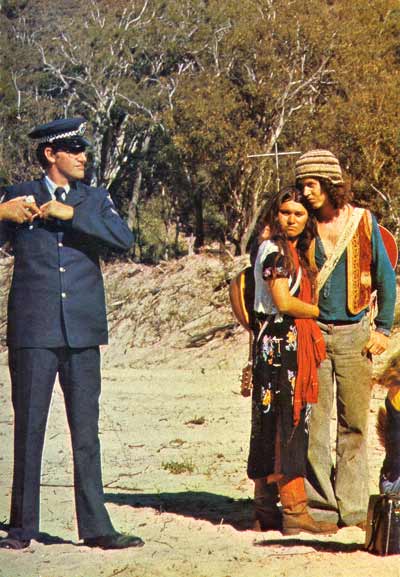 1979 Australia: The first edition of Maggie's Farm magazine went on sale, founded by your almanackist one sunny day, and edited in its first 20 editions by him and Robyn Arianrhod.
Its purpose was exemplified by its motto 'Participation Press'. That is, in a move anticipating open source, it published material (articles, poems, photos, etc) submitted by its readers. Founded with $50 and 30 days' credit at a printer (Bellinger Courier-Sun), the magazine locally sold out 1,000 copies of the first issue, and before long was circulating 4,500 in virtually every newsagency in Australia. The magazine, transmogrified into something appealing, but not 'participation press', ran for another seven years under the editorship of my mate Paul White. Other titles I considered: Yellow Delaney and Runcible Spoon. Pictured at right, a cover photo.
[And now all four Bruces launch into the Philosophers' song]
Listen to song in mp3
Immanuel Kant was a real piss-ant who was very rarely stable.
Heidegger, Heidegger was a boozy beggar who could
think you under the table.
David Hume could out-consume Schopenhauer and Hegel.
And Wittgenstein was a beery swine who was just as sloshed as Schlegel.
There's nothing Nietzsche couldn't teach 'ya 'bout the raising of the wrist.
Socrates, himself, was permanently pissed.
John Stuart Mill, of his own free will, after half a pint of shandy was
particularly ill.
Plato, they say, could stick it away, 'alf a crate of whiskey every day!
Aristotle, Aristotle was a bugger for the bottle,
And Hobbes was fond of his Dram.
And Rene Descartes was a drunken fart:
"I drink, therefore I am."
Yes, Socrates himself is particularly missed;
A lovely little thinker, but a bugger when he's pissed.
Tomorrow: Half-hanged Maggy; Great Fire of London
Pip Wilson posted item above at 7:18 PM | Permalink





1 Comments:
That was a pretty good blog post, Pip.
Post a Comment
<< Home